K20 vs K24 Engine – Which Is Better for Swap?
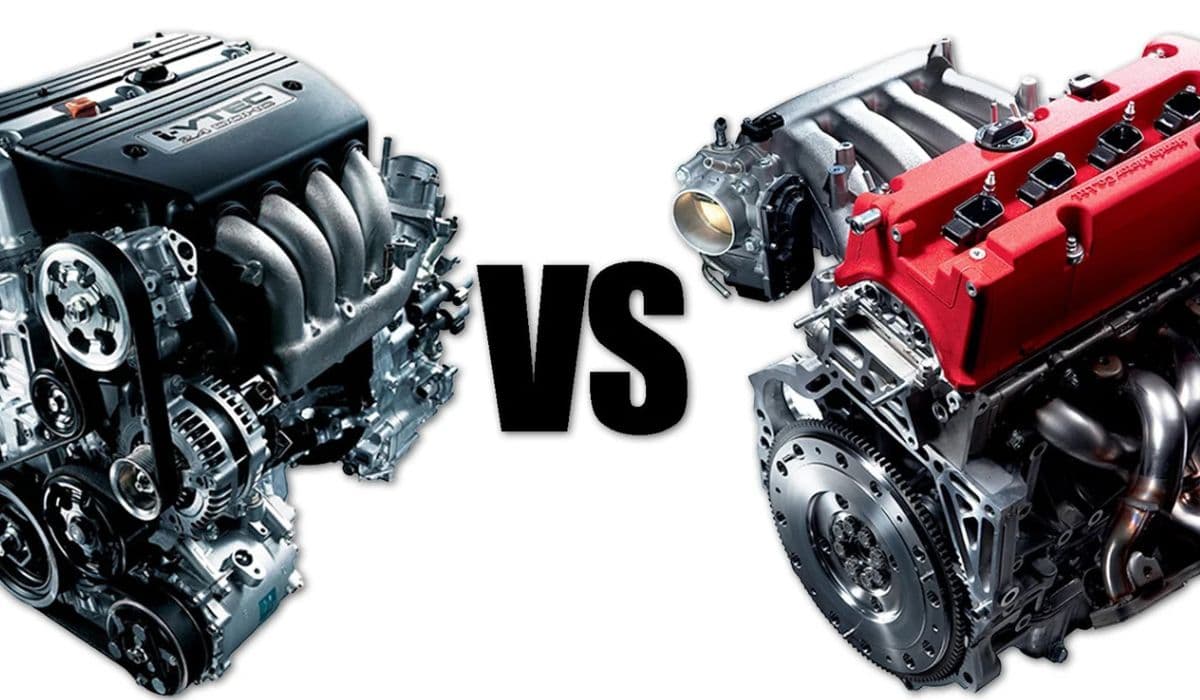
The Honda K-series has become the gold standard for engine swaps in the Honda community and beyond. Whether you’re building a track-focused Civic, a sleeper Accord, a boosted CRX, or even a non-Honda project like an MR2 or Mini, the two most popular choices always come down to the K20 and K24. Both are excellent, but they serve very different purposes. This in-depth comparison will help you decide which one truly deserves a place in your swap bay.
Power Potential and Factory Output
The K20 family (K20A, K20A2, K20Z1, K20Z3, K20Z4, K20C, etc.) is known for high-revving character and strong specific output. Most performance-oriented K20s from RSX Type-S, Civic Type R (EP3, FN2, FD2), and Civic Si produce between 200 and 225 hp naturally aspirated in stock form, with redlines ranging from 8000 to 8600 rpm.
The K24 variants (K24A1, A2, A3, A4, Z1, Z3, Z7, etc.) are displacement advantage (2.4 L vs 2.0 L) gives them significantly more factory torque. A typical K24A2 from a TSX makes 200–205 hp but 164–171 lb-ft of torque, while the later K24Z3 (2012–2015 Civic Si) pushes ~205 hp and 174 lb-ft. Even the lower-spec K24A1 from early CR-Vs and Elements still produces around 160 hp and 162 lb-ft – numbers that many K20s only reach after bolt-ons.
Winner for pure power potential: K24 when boost is planned, K20 when staying naturally aspirated and chasing 9000+ rpm.
Bottom End Strength and Rod Ratio
One of the most discussed topics is bottom-end durability under high boost or extreme RPM.
K20 engines (except very early K20A3) use forged crankshafts and strong powdered-metal connecting rods with a rod/stroke ratio of ~1.61. This excellent ratio is the main reason K20s rev so freely and safely to 8600–9000 rpm on stock internals.
K24 blocks are split into two major categories:
Early 99 mm tall deck (K24A1, A2, A4, A8) – same crank and rods as high-performance K20s, same 1.58–1.59 rod ratio.
Later 104 mm tall deck (K24Z1 and newer) – longer 152 mm connecting rods and 99 mm stroke crank, giving a much better 1.68–1.70 rod ratio, but the rods are slightly weaker than the older forged units.
For all-motor builds chasing 9000 rpm, the early K24A2 block + K20A2/K20Z3 head (“Frankenstein” combo) with K20 oil pump and chain tensioner is still king. For boost above 400–500 whp, the newer K24Z7/Z3 sleeved or aftermarket sleeved blocks with upgraded rods are the safest choice.
Cylinder Head and VTEC Differences
The K20 performance heads (PRC, PRB, PPC, RBC, RBB) feature larger intake valves, better port velocity, and aggressive cam profiles on the VTEC lobe (11.5–12.5 mm lift, 240–260° duration). i-VTEC on K20Z1/Z3/Z4 adds variable intake cam phasing on top of traditional VTEC.
K24 heads are generally more emissions-friendly with milder cams and smaller valves. The best factory K24 head is widely considered the K24A2 (TSX) – 50° VTC, decent ports, and 10.5 mm intake lift. The later K24Z-series heads have even smaller ports and cams optimized for mid-range torque and fuel economy.
Most serious K24 swap builds immediately swap to a K20 Type-R or RSX-S head (RBC/RBB/PRB) for 30–50+ hp gains over any stock K24 head.
Transmission and Drivability Considerations
K20s were paired almost exclusively with excellent 6-speed manual transmissions (02–06 RSX-S, 06–11 Civic Si, 02–05 Civic Type R). Gear ratios are close, final drive is aggressive (4.7–5.1), and the shifter feel is legendary.
Most K24s came with weaker 5-speed gearboxes or CVT automatics. The rare exceptions are the 06–11 Civic Si (same box as K20Z3) and Accord Euro-R/TSX 6-speed. This is why 90 % of K24 swaps reuse a K20 6-speed transmission – it simply bolts up with the correct intermediate shaft and clutch/flywheel combo.
Axle and half-shaft strength becomes a concern above 400 whp. Most builders upgrade to DSS or Insane Shafts Level 3–5 axles regardless of K20 or K24.
Physical Size and Swap Clearance Issues
The K24’s taller deck height (especially post-2007 blocks) creates hood clearance problems in EG, EK, DC2, and many classic chassis. You often need a 1–2 inch hood spacer, low-profile intake manifold (Skunk2 Ultra, Rcrew), or a custom hood.
K20 fits almost everywhere a B-series did, with far fewer modifications. This is the single biggest reason many people still choose K20 for lightweight cars – no cutting, no spacers, no headache.
Cost of Acquisition and Availability
K20A2 (RSX Type-S) complete swap packages still command premium prices – often $4500–7000 USD depending on mileage and condition.
K24A2 (02–06 TSX) swaps have become the budget king – complete longblocks frequently sell for $1500–2500, and full swaps with ECU and harness can be found under $3500.
Newer K24Z3/Z7 engines from 9th-gen Civics are even cheaper and more plentiful in wrecking yards, though they require more wiring work (immobilizer, drive-by-wire).
Fuel Economy and Emissions
If the car is a daily driver, the K24 wins hands down. Real-world testers regularly see 32–38 mpg in EF/EG/EK Civics with K24A2 + conservative tuning. K20 swaps rarely exceed 30–32 mpg under the same conditions.
For areas with strict visual or sniffer emissions tests, K24A2/A4 with stock TSX or Accord ECU and catalytic converter is far easier to keep legal than most K20 Type-R variants.
Tuning and Aftermarket Support
Both engines enjoy massive aftermarket support, but the K24 has pulled ahead in the last 5–7 years. Companies like 4Piston, Drag Cartel, IPG, and ERL offer turn-key 1000+ hp sleeved K24 short and long blocks. K20 aftermarket is still strong, but the ceiling is generally accepted to be around 700–800 whp on stock sleeves before the cylinders walk.
Real-World Performance Examples
All-motor: 240–270 whp is common with K24A2 block + K20 head + 12.5–13.5:1 compression + cams.
Turbo: 500–600 whp on stock K24 sleeve is considered safe with good tuning; 800–1200+ whp on sleeved K24 is routine in the fastest FWD drag cars.
K20 turbo builds typically stop at 450–550 whp on stock sleeves to stay reliable.
Which One Should You Choose?
If your goal is a lightweight, razor-sharp street car that revs to the moon and feels like a motorcycle – get a K20A/A2/Z3.
If you want tire-shredding torque from 3000 rpm, easier 500+ whp on pump gas, better mileage, and cheaper parts – the K24 (especially K24A2 or sleeved Z-series) is almost always the smarter choice.
Most experienced builders now agree: for 95 % of swaps in 2025, the K24 platform offers more power, more reliability under boost, and better value – as long as you’re willing to do the common hybrid modifications (K20 head, K20 6-speed, etc.).