How to Change Rear Differential Fluid on 2020-2024 Ford Explorer (6th Generation) – Complete Step-by-Step Guide
The sixth-generation Ford Explorer (2020-present) uses a rear differential that requires regular fluid changes to prevent premature wear, whining noises, overheating, and expensive repairs. Whether you have the standard open differential, the optional limited-slip unit on ST and Timberline models, or the electronic locking differential on certain Police Interceptor packages, performing a rear differential fluid change every 30,000–50,000 miles (or sooner in severe towing conditions) dramatically extends component life.
This detailed guide covers every aspect of the 2020-2024 Explorer rear axle service, including correct fluid specifications, torque values, tools, common pitfalls, and pro tips most DIY videos miss.
Identifying Your Explorer’s Rear Differential Type
Before buying fluid, determine which rear axle you have:
Most Explorers (Base, XLT, Limited, Platinum 2.3L/3.0L RWD and AWD) – Ford 8.8-inch ring gear with conventional open differential
Explorer ST and some Platinum 3.0L AWD – 8.8-inch with clutch-type limited-slip differential
Explorer Timberline – heavier-duty 8.8-inch with Torsen limited-slip
Police Interceptor Utility – often equipped with electronic locking rear differential
The axle code is printed on the door certification label (driver’s door jamb). Common codes:
C9 = open 3.31
K9 = open 3.58
L9 = limited-slip 3.73 (ST)
H9 = electronic locking 3.73
Official Ford Fluid Specifications and Best Alternatives
Ford specifies:
Open differential – Motorcraft XY-80W90-QL (80W-90 GL-5)
Limited-slip differentials (ST, Timberline, some Platinum) – Motorcraft XY-75W85-QLS (75W-85 synthetic) + 4 oz (118 ml) of XL-3 Friction Modifier
Electronic locking differential (Police) – same 75W-85 + friction modifier
Real-world proven alternatives that meet or exceed Ford specs:
Mobil 1 Synthetic 75W-90 (open diff)
Red Line 75W-85 GL-5 + Red Line friction modifier (limited-slip)
Amsoil Severe Gear 75W-90 or 75W-110 (excellent for towing/heavy use)
Ravenol DGL 75W-85 (OEM supplier for some Ford plants)
Capacity: approximately 1.8–2.0 quarts (1.7–1.9 liters). Always fill until fluid runs out of the fill hole with the vehicle perfectly level.
Required Tools and Supplies
3/8" ratchet (no extension needed for plugs)
13 mm wrench (for fill plug on some axles)
24 mm or 30 mm socket (drain plug varies by year)
Fluid pump (hand pump, bottle or suction gun)
Drain pan
Torque wrench (20–150 ft-lb range)
Nitrile gloves, rags, brake cleaner
Jack stands + wheel chocks
Optional: Mityvac 7201 or Power Probe fluid extractor for cleaner fill
Step-by-Step Rear Differential Fluid Change Procedure
Safety First Park on a level surface, chock front wheels, engage parking brake. If lifting the rear, use jack stands under the axle or frame rails – never rely only on a floor jack.
Warm the Differential (Recommended) Drive 10–15 minutes to bring fluid to operating temperature. Warm fluid drains faster and carries out more contaminants.
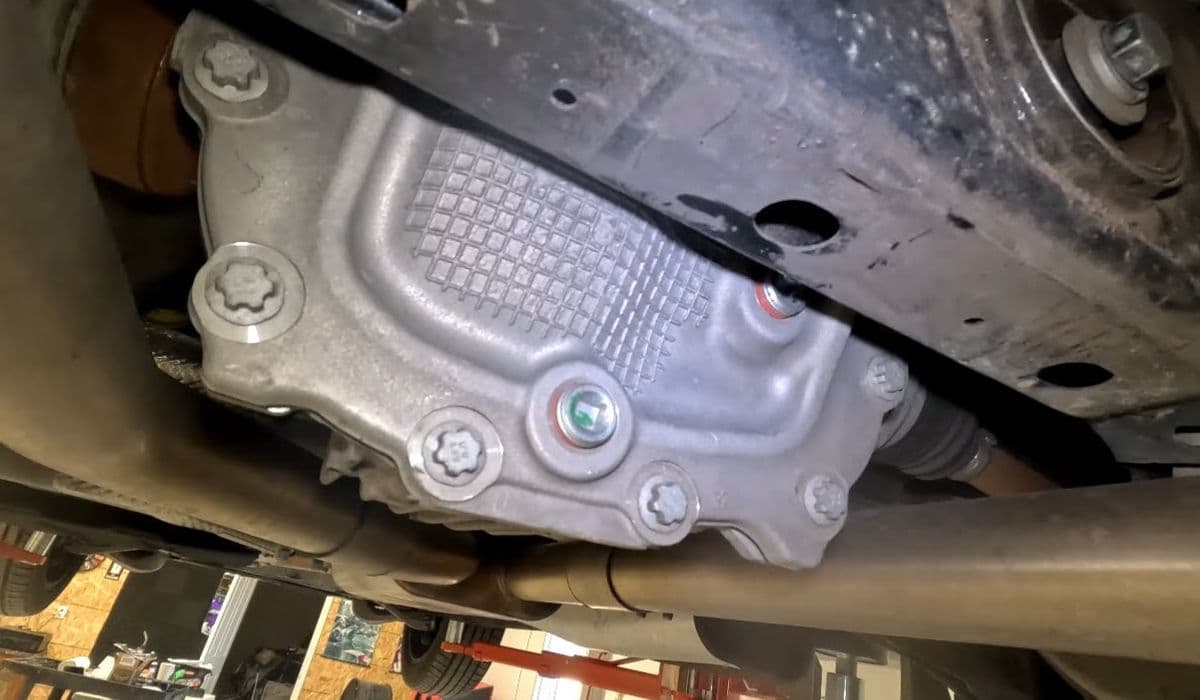
Remove the Fill Plug First This is critical. The fill plug is on the passenger side of the differential housing (higher than drain). Use a 3/8" ratchet or 13 mm wrench. Removing it first ensures you can refill later if the drain plug is seized.
Drain the Old Fluid The drain plug is at the bottom of the housing. 2020-2022 models usually have a 24 mm hex drain plug; 2023-2024 switched to 30 mm on many units. Place a drain pan directly underneath – fluid will shoot out sideways. Let it drain completely (10–15 minutes).
Inspect the Drain Plug Magnet The drain plug has a strong magnet. Clean off metal paste/shavings with brake cleaner and a rag. A light gray film is normal; large chunks or glitter indicate internal wear.
Clean the Housing (Optional but Recommended) Spray brake cleaner into the drain hole and let it flush out remaining sludge. Some techs pour a small amount of new fluid in the fill hole, reinstall drain plug temporarily, shake the truck side-to-side, then drain again.
Reinstall Drain Plug Clean threads, apply a thin layer of Teflon paste (not tape) if the plug does not have an integrated rubber o-ring. Torque spec: 30 ft-lb (40 Nm) – do not overtighten aluminum housings.
Pump New Fluid Insert pump hose fully into the fill hole. Pump slowly until clean fluid drips steadily from the fill hole. This usually takes 1.8–1.9 quarts. Limited-slip models: add 4 oz (118 ml) XL-3 or equivalent friction modifier first, then top off with 75W-85.
Reinstall Fill Plug Torque: 30 ft-lb (40 Nm)
Wipe Excess & Check for Leaks Clean the area, lower the vehicle, and check for drips after a short drive.
Torque Specifications Summary (Critical)
Drain plug – 30 ft-lb (40 Nm)
Fill plug – 30 ft-lb (40 Nm)
Differential cover bolts (if removed) – 28 ft-lb in star pattern
Common Problems and How to Avoid Them
Stripped fill/drain plugs – use 6-point sockets and penetrate oil overnight if seized
Overfilling – vehicle must be level; fluid should just dribble out, not pour
Wrong fluid in limited-slip – causes chatter during turns
Leaking axle seals after service – usually from old seals disturbed during lifting; replace if needed
Severe Service Interval
Ford considers “severe service” (towing, off-road, police, frequent short trips) to require fluid changes every 30,000 miles. Highway-only drivers can extend to 50,000–60,000 miles, but most owners report noticeably quieter operation even at 40,000 miles.
Signs Your Rear Differential Needs Service Sooner
Whining or howling on deceleration 40–60 mph
Clunk when shifting from R to D
Vibration felt in the seat
Burnt smell from rear of vehicle
Metal flakes on drain plug magnet
Performing this service yourself costs $50–$80 in fluid versus $200–$350 at a dealership or independent shop. The job takes 30–45 minutes once the vehicle is in the air.
More from Ford
How to Permanently Fix F-150 EcoBoost Gurgling Noise with the Condensation Drain Mod
08.12.2025 09:31
How to Delete Active Grill Shutters F-150
08.12.2025 09:13
Mustang GT 2018-2023 Oil Pump Gear Failure: DIY Inspection Guide
08.12.2025 06:34
Ford Explorer Police Interceptor Oil Pan Gasket Replacement: Complete Professional Guide
08.12.2025 06:21
H10R80 Transmission Fluid and Filter Change DIY – Complete Step-by-Step Guide for Ford 10-Speed Owners
08.12.2025 06:18